
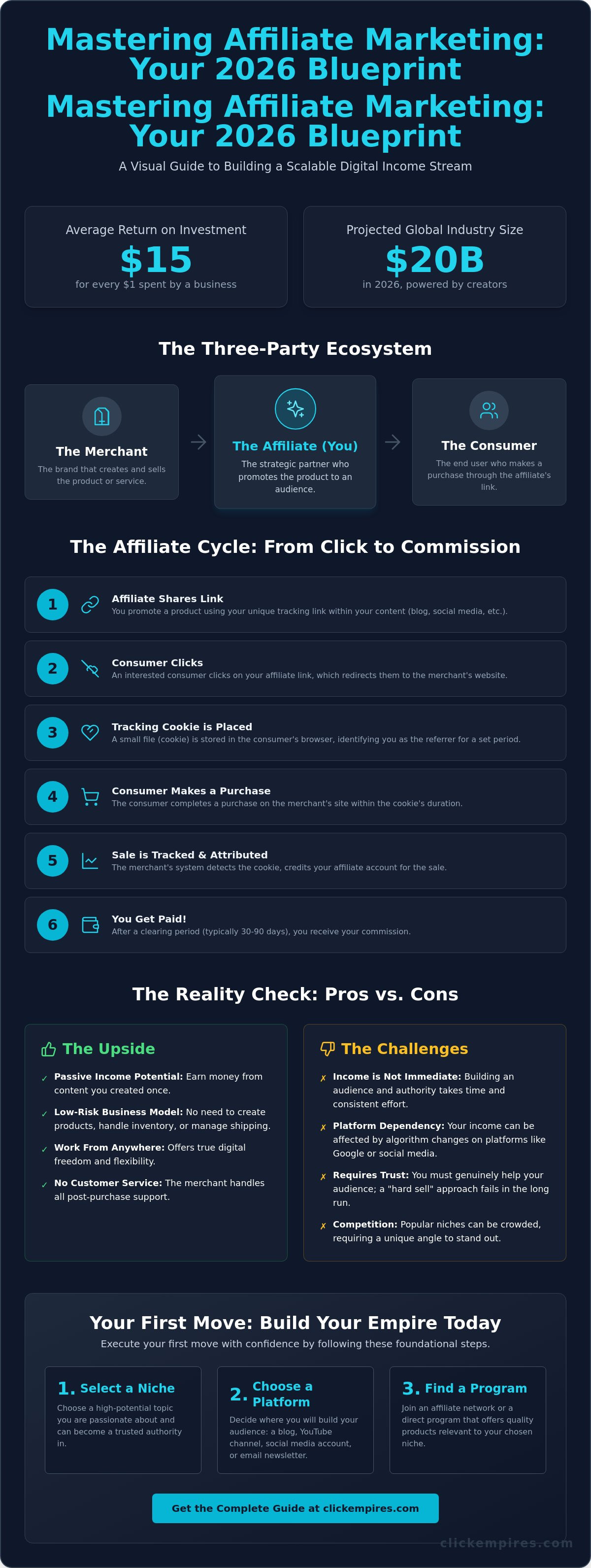
Did you know that for every dollar a business spends on affiliate marketing, they see an average return of up to $15? In 2026, this isn't just a hobby for bloggers. It is a $20 billion global industry powered by creators who know how to bridge the gap between a consumer's problem and a brand's solution. You are likely here because you want to know what is affiliate marketing and how does it work without getting lost in a sea of technical jargon or "get rich quick" scams.
It is completely normal to feel paralyzed by information overload or the fear of making a technical mistake with tracking links. You want a legitimate path to digital freedom, but the mechanics can feel like a high wall to climb. This guide changes that. We're going to master the mechanics of affiliate marketing together and show you how to transform strategic partnerships into a scalable, professional income stream.
We will break down the complete affiliate cycle from start to finish. You'll gain the confidence to choose a winning strategy and the exact steps needed to build your digital empire while staying fully compliant with the latest 2026 regulations. It's time to stop planning and start executing.
Key Takeaways
- Master the three-party ecosystem between merchants, affiliates, and consumers to build a reliable income source.
- Clear the confusion around what is affiliate marketing and how does it work by learning the exact cycle of tracking links and commissions.
- Compare unattached and related strategies to choose the path that matches your personal authority and goals.
- Prepare for the reality of the creator economy by weighing the benefits of passive income against the need for platform resilience.
- Execute your first move with confidence by selecting a high-potential niche and the right digital platform for your brand.
The Blueprint: Defining Affiliate Marketing for 2026
Affiliate marketing is a performance-based partnership where you earn commissions for driving sales. It is the ultimate low-risk business model for 2026 because it removes the traditional barriers to entry. You don't need a warehouse. You don't need a customer service team. You don't even need to create your own product. You simply bridge the gap between a consumer's need and a brand's solution. To truly master what is affiliate marketing and how does it work, you must view it as a professional collaboration rather than a side hustle.
This model operates within a three-party ecosystem. First, you have the Merchant, the brand that creates and sells the product. Second, there is the Affiliate, which is you. You act as the strategic partner who introduces the product to an audience. Finally, there is the Consumer. They complete the cycle by making a purchase through your unique link. According to the historical overview of Affiliate Marketing, this structure has evolved from simple referral links into a sophisticated digital economy where transparency and value are the primary currencies.
The digital landscape has shifted. We have moved away from "traffic hunting," where marketers would blast links across the web. Success today requires authority building. You aren't just a middleman; you are a trusted advisor. In a world of information overload, consumers look for experts to filter the noise for them. By positioning yourself as a niche authority, you turn one-off clicks into a scalable digital income stream.
The Core Vocabulary You Must Know
- Commissions: This is your revenue. It is typically paid as a percentage of the total sale or a fixed flat fee per lead or purchase.
- Affiliate Networks: These are digital marketplaces that act as intermediaries. They connect you with thousands of brands, handle the tracking, and ensure you get paid on time.
- Creatives: These are the assets provided by the merchant. They include banners, email templates, and pre-written copy designed to help you promote effectively.
Why Brands Love Affiliates
Businesses are moving away from massive, unpredictable ad spends. They love affiliates because we provide low-risk customer acquisition. The brand only pays when a result is achieved. This performance-based model allows them to reach hyper-specific niche audiences that traditional advertising often misses. Your recommendation carries the weight of third-party social proof. In a skeptical market, a real person's endorsement is worth more than any corporate commercial. You provide the trust that closes the sale.
The Engine Room: How the Affiliate Cycle Actually Operates
Understanding the mechanics is where your journey moves from theory to execution. To master what is affiliate marketing and how does it work, you need to see the gears turning behind the scenes. It starts when you join an affiliate program or network. Once approved, you receive a unique tracking ID. This ID is your digital signature. It ensures every sale you generate is credited back to your account. You aren't just sharing a link; you are deploying a sophisticated tracking asset.
Your work begins with content. You create high-value resources that naturally integrate your links. When a consumer clicks that link, a tracking cookie is placed in their browser. This cookie monitors their journey. If they make a purchase within the allowed window, the merchant’s system recognizes your ID. The conversion is tracked. The sale is attributed to you. Finally, you receive your commission after a clearing period, which typically lasts 30 to 90 days to account for potential returns or fraud checks.
Understanding Tracking in a Privacy-First World
Tracking has evolved significantly. While cookies are still common, the 2026 landscape utilizes more robust methods like server-side attribution and custom coupon codes. These tools ensure you get paid even as browser privacy settings become more strict. Transparency is no longer optional. According to the FTC Endorsement Guides, you must clearly disclose your relationship with the brand. Honesty builds trust. Trust drives clicks. If you want to streamline this process, checking out professional affiliate marketing guides can help you set up your tracking correctly from day one.
The Payout Structure: How You Get Paid
- Pay-Per-Sale (PPS): This is the standard. You earn a percentage when a customer buys a physical or digital product.
- Pay-Per-Lead (PPL): You get paid for actions. This could be a newsletter sign-up, a free trial, or a completed form.
- Recurring Commissions: This is the path to true scalability. You earn a commission every month the customer remains a subscriber to a software or service.
The clearing period might seem long at first. Merchants use this time to verify that the sale is legitimate. It is a safety net for the brand. However, once your pipeline is full, these payouts create a steady, predictable flow of income. Mastery comes from understanding these technical layers so you can focus on what matters most: serving your audience and building momentum.
The Three Pillars: Choosing Your Affiliate Strategy
Success in this industry isn't one-size-fits-all. You need a strategy that matches your resources, your risk tolerance, and your long-term vision. To truly grasp what is affiliate marketing and how does it work at a professional level, you must choose between three primary engagement models. These pillars define how you interact with your audience and how you position the products you promote. Your choice will determine whether you are building a quick cash flow or a lasting digital empire.
The three pillars of affiliate engagement are:
- Unattached Affiliate Marketing: A purely tactical approach where you have no authority in the niche and rely on paid ads.
- Related Affiliate Marketing: Promoting products within your niche that you don't necessarily use, leveraging your general topical authority.
- Involved Affiliate Marketing: The gold standard for 2026. You promote products you use, love, and stand behind personally.
Involved marketing generates the highest conversion rates today. Consumers are tired of generic ads. They want real experiences. When you show exactly how a product solved a problem in your life, you move from being a salesperson to a trusted advisor. This authenticity is the most valuable currency you have in the digital marketplace.
Unattached: The High-Speed Data Play
If you prefer numbers over networking, this might be your path. You use platforms like Google or Meta to buy traffic and send it directly to a merchant's landing page. It's fast. You can scale a winning campaign in hours. However, the risk is significant because you are spending your own capital upfront. Unattached marketing is a purely tactical arbitrage play that requires a deep understanding of data.
Involved: Building Your Personal Empire
Building an empire is about longevity. Use blogs or social channels to build EEAT: Experience, Expertise, Authoritativeness, and Trust. A recommendation feels like advice from a friend, while an advertisement feels like a sales pitch. Following the FTC Endorsement Guidelines proves you value your audience. Honest disclosures reinforce your authority and drive higher sales.
Choosing your pillar is the first step toward mastery. While unattached models offer speed, involved models offer security and higher margins. In 2026, the most successful affiliates are those who prioritize the human connection. They don't just hunt for clicks. They build communities that rely on their expertise to make informed buying decisions. Decide which path fits your personality and start building your momentum today.
The Reality Check: Pros, Cons, and the Self-Starter Mindset
To truly master what is affiliate marketing and how does it work, you must look past the flashy screenshots of high earnings. This is a business of endurance. Most beginners quit within the first 90 days because they hit the "valley of disappointment." This is the period where your effort is high, but your commissions haven't cleared yet. You avoid this trap by adopting a self-starter mindset. Treat this as a professional career from day one; not a casual hobby. Success is a result of consistent execution, not luck.
The global affiliate market is valued at over $20 billion in 2026, and over 80% of brands now utilize these programs. The opportunities are massive, but the field is competitive. You need to weigh the freedom against the responsibility. Consider these factors before you dive in:
- The Pros: You enjoy location independence and passive income potential. There is zero stress regarding product creation, inventory, or shipping. You can scale as fast as your traffic grows.
- The Cons: You will face delayed payouts and high competition. You are also reliant on merchant platforms; if they change their terms or commission rates, your income can shift overnight.
Overcoming the Payout Gap
Managing your cash flow is critical during your first few months. Since clearing periods often last 30 to 90 days, you must plan your finances accordingly. Don't put all your eggs in one basket. Diversify your affiliate partners so you aren't dependent on a single brand's payout schedule. To stay on track, utilize professional productivity tools that help you organize your links and track your content schedule. Systems beat willpower every time.
Standing Out in a Crowded Market
The era of thin, generic content is over. In 2026, a "quality-first" approach is the only way to win. Deep-dive reviews that show real-world usage beat generic listicles every time. Use AI to enhance your research and data analysis, but never use it to spam low-quality content. Focus on a "nano-niche" to gain immediate authority. For example, instead of targeting "software," focus on "remote work software for graphic designers." Becoming a big fish in a small pond allows you to build trust faster and dominate your corner of the market.
Your First Move: Building Your Click Empire Today
You have the blueprint. You understand what is affiliate marketing and how does it work in theory. Now it's time to move from planning to execution. Building a digital empire starts with a single, strategic decision. You need to choose where you'll play and how you'll win. This isn't about chasing every shiny object. It's about focused, relentless action in a niche that rewards your expertise and solves real problems for your audience.
Your first move is picking your niche. You need a balance between personal interest and profit potential. If you love the topic, you'll stay consistent. If the topic is profitable, you'll stay motivated. Once you have a niche, choose your platform. Will you build a content-rich website, a high-energy video channel, or a direct-to-consumer email list? Pick one. Master it. Diversity comes only after you've achieved stability and steady cash flow.
Finding Your Profit Zone
Not all niches are created equal. In 2026, the evergreen sectors remain Health, Wealth, and Relationships. These are areas where people are always looking for solutions and are willing to invest in their growth. To maximize your early ROI, focus on high-margin digital products. Digital downloads like ebooks and online courses offer commission rates between 30% and 70%. Compare this to physical goods, which often hover between 5% and 15%. By promoting digital assets, you earn significantly more for every click you generate. For deeper insights into these high-profit models, explore Click Empire's affiliate marketing guides to refine your strategy.
Scaling to Mastery
Consistency is the only real secret to scaling from zero to five figures. Most people fail because they stop right before the momentum kicks in. As you grow, your role must shift. You'll move from doing every manual task to using productivity tools for automation. This allows you to focus on high-level strategy while your systems handle the routine tracking and distribution. Investing in your own growth is non-negotiable. Use specialized resources to stay ahead of the curve and adapt to the fast-paced digital environment. Ready to take the leap? Start your journey with Click Empire’s digital resources and build your future today.
Master Your Digital Future Today
You now have a complete understanding of what is affiliate marketing and how does it work in the modern economy. You've moved from curiosity to a strategic blueprint. Success isn't about luck. It is about building authority and choosing high-margin digital products that solve real problems. The transition from planning to execution is where most people stall, but you have the tools to push through the initial payout gap. Focus on the involved strategy to build deep trust with your audience.
It's time to stop researching and start building. Your digital empire won't create itself, but with the right systems, it can become a scalable income stream. Build your digital empire with our expert Affiliate Marketing Guides. Our resources are designed for the modern self-starter and feature action-oriented strategies focused on high-margin digital products. You have the knowledge. Now, take the first step toward your professional independence. Your future is waiting for you to execute.
Frequently Asked Questions
Is affiliate marketing still profitable in 2026?
Yes, it is more profitable than ever. The global market is valued at over $20 billion in 2026; it is projected to grow to over $82 billion by 2035. Businesses earn an average return of $6.50 for every $1 spent on affiliate partnerships. Success now requires building trust and authority rather than just hunting for traffic. It is a high-growth sector for anyone willing to execute a strategic plan.
How much money do I need to start affiliate marketing?
You can start with zero capital if you leverage organic social media platforms. However, most professional self-starters invest in a domain name and basic hosting to build their own digital asset. This usually costs less than $100 per year. Avoiding high upfront costs is a major benefit of this model. You focus your resources on content creation and audience engagement rather than inventory or overhead expenses.
Do I need a website to start affiliate marketing?
No, a website is not strictly required to begin. You can drive traffic through YouTube, TikTok, or email lists. However, owning a website gives you full control over your data and tracking links. It acts as your digital headquarters. While you can start on social media, building a site is the best way to ensure long-term stability and professional branding as you scale your digital empire.
How long does it take to see the first commission?
Most beginners see their first commission within three to six months. This timeline depends on your chosen strategy and how much time you invest in content production. SEO-driven sites take longer to gain momentum; paid advertising can generate results in days. Consistency is the primary factor. If you treat this as a career and execute daily, you will shorten the gap between starting and earning.
What is the best niche for affiliate marketing beginners?
The best niche combines your personal interest with high profit potential. Health, Wealth, and Relationships are evergreen sectors because they solve fundamental human problems. If you want to understand what is affiliate marketing and how does it work for maximum ROI, look at digital products or SaaS. These often offer recurring commissions. Pick a specific sub-niche to avoid heavy competition and establish your authority quickly.
Is affiliate marketing a scam or a pyramid scheme?
No, it is a legitimate performance-based marketing model used by over 80% of global brands. Unlike a pyramid scheme, there is no requirement to recruit others to earn money. You are paid a commission for generating actual sales or leads for a merchant. It is a professional collaboration between brands and creators. Your income is directly tied to the value and trust you provide to your audience.
Can I do affiliate marketing on social media without a following?
Yes, you can start today even with zero followers. Short-form video platforms like TikTok and Instagram Reels use interest-based algorithms that can push your content to thousands of people instantly. You don't need a massive audience; you need a highly engaged one. Focus on creating helpful, specific content that solves a problem. High-quality recommendations will drive clicks regardless of your current follower count.
What are the most common mistakes beginners make?
The biggest mistake is quitting during the first 90 days before commissions clear. Beginners also fail by spamming links without providing real value or ignoring legal requirements like FTC disclosures. To succeed, you must master what is affiliate marketing and how does it work by focusing on the user experience. Build trust first. The sales will follow once your audience views you as a reliable expert in your niche.