
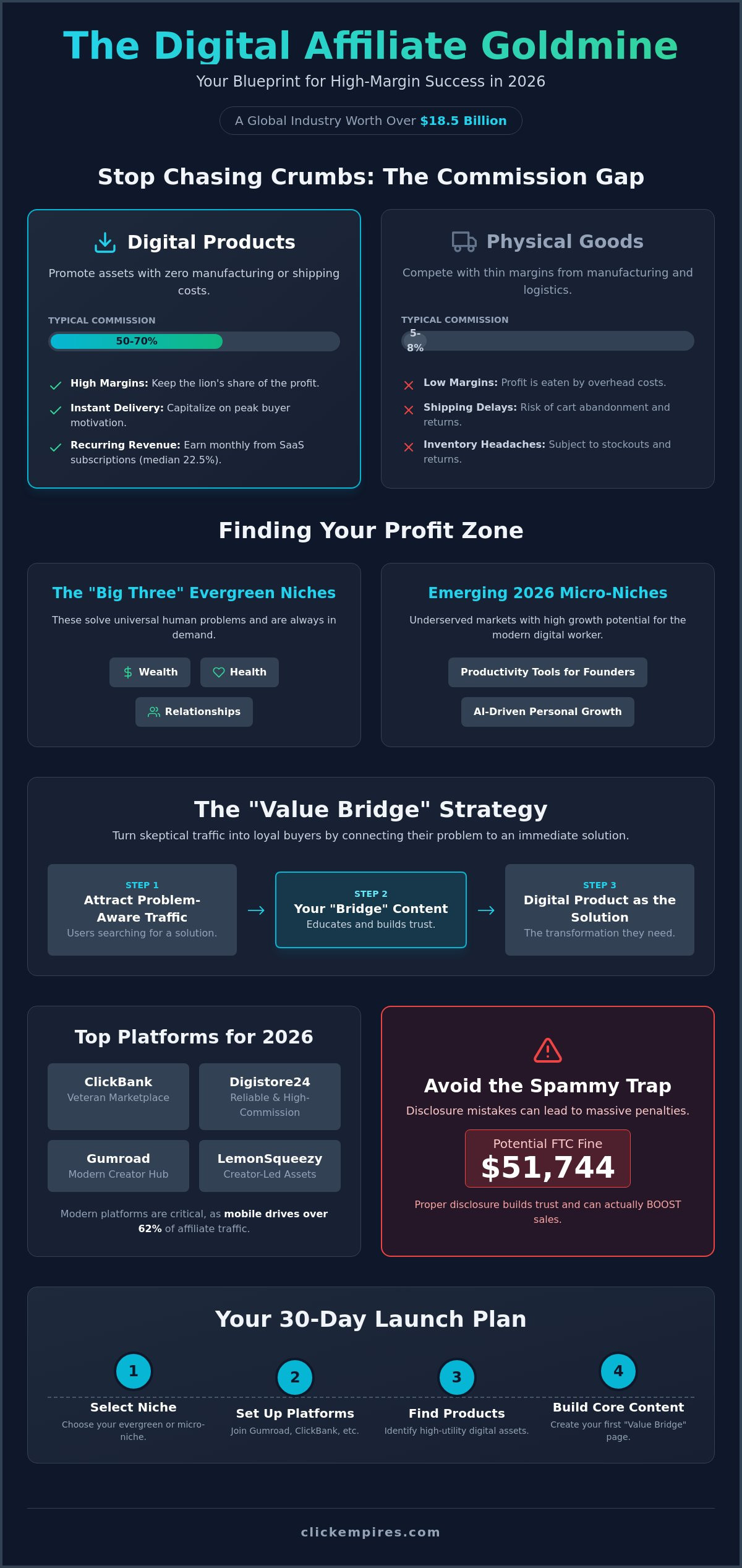
Most marketers are working too hard for crumbs while the real profit is hiding in plain sight. If you're still chasing 5% commissions on physical goods, you're leaving a fortune on the table. The global affiliate industry is now worth over $18.5 billion, and the fastest way to get your share is through affiliate marketing for digital products. It's the only path where 50% to 70% commissions are the standard, not the exception.
You probably know the frustration of low conversion rates and the headache of finding products that don't feel scammy. It's easy to get overwhelmed by the technical setup and the fear of missing a $51,744 FTC fine for a simple disclosure mistake. You want a passive income stream that actually works, but the path from clicking "join" to seeing a deposit often feels like a maze. This guide is your map to high-margin success in 2026.
We'll show you how to build a Value Bridge that turns skeptical traffic into loyal buyers. You'll learn to identify the most profitable niches for the year ahead and master the exact strategies to scale your sales without the technical burnout. Let's move from planning to execution and start building your digital empire today.
Key Takeaways
- Learn how affiliate marketing for digital products allows you to capture 50-70% commissions by promoting assets with zero manufacturing or shipping costs.
- Identify the "Big Three" evergreen niches and the emerging 2026 micro-niches that are currently underserved and ready for growth.
- Master the anatomy of a "Bridge Page" to effectively connect a user's specific problem to a digital solution that offers an immediate transformation.
- Shield your business from legal risks and build buyer confidence by implementing 2026-compliant disclosure strategies that actually boost sales.
- Execute a clear 30-day roadmap to select your niche, set up on platforms like Gumroad, and build your core content foundation.
Why Digital Products are the Affiliate Goldmine in 2026
Affiliate marketing for digital products is the ultimate shortcut to high-margin revenue. Unlike traditional retail, you aren't selling heavy boxes or waiting for cargo ships. You're promoting intangible assets like ebooks, software, and online courses. To understand the foundation of this industry, you can explore What is Affiliate Marketing? and how it has evolved into the powerhouse it is today. In 2026, the global industry is valued at over $18.5 billion. Consumers are shifting their spending toward self-improvement downloads at record rates. They want solutions now, not in three to five business days.
Physical goods are often a race to the bottom. Between manufacturing, storage, and labor, the margins are razor-thin. You might earn a tiny 5% commission on a pair of sneakers. Digital products have zero overhead after the initial creation. This is why affiliate marketing for digital products is the goldmine of the decade; you capture the lion's share of the profit because the creator has no shipping costs to cover. The comparison is clear:
- Physical Goods: Low margins (5-8%), shipping delays, and high return rates.
- Digital Products: High margins (50-70%), instant delivery, and zero manufacturing costs.
The Economics of Digital Commissions
Quality digital guides usually start at a 50% commission baseline. If you sell a $100 productivity course, you keep $50. No deductions for shipping or warehouse fees. Software-as-a-Service (SaaS) products offer an even more lucrative deal. Many pay a median of 22.5% in recurring commissions for the first year. You make the sale once and get paid every month the user stays active. It's the most efficient engine for building a passive income stream without the headache of inventory management.
Instant Delivery: The Psychology of the Digital Buyer
The "Instant Download" button is a powerful psychological trigger. It drastically reduces cart abandonment because there's no friction between the payment and the reward. In 2026, buyers are less patient. They value speed and self-actualization over physical clutter. In niches like self-help and health, people are looking for immediate relief from a problem. You're capitalizing on that impulse buy window when their motivation is at its peak. Digital affiliate marketing is a performance-based value-exchange model for 2026 that connects problem-solving creators with audiences seeking immediate digital transformations.
Finding Your Profit Zone: The Best Niches and Platforms
Finding your niche is the first real hurdle. You don't want to be everywhere; you want to be where the profit is. The "Big Three" niches, Wealth, Health, and Relationships, remain the titans of the industry because they solve universal human problems. But in 2026, the real momentum is in micro-niches. Look at productivity tools for remote founders or AI-driven personal growth resources. These areas aren't just trendy. They're essential for the modern digital worker who needs to stay competitive. Success in affiliate marketing for digital products depends on your ability to spot these shifts before everyone else does.
Many beginners make the mistake of chasing "High Gravity" products on marketplaces. Gravity tells you a lot of people are making sales, but it doesn't tell you about the refund rates or the actual utility of the product. You need to look for high utility. Does this digital guide actually solve a problem? If the product is junk, your reputation takes the hit. If you're ready to start building your own portfolio of high-converting offers, you can explore our latest affiliate marketing guides to sharpen your strategy.
Top Platforms for Digital Affiliates in 2026
Platforms like ClickBank and Digistore24 are the veterans. They're reliable for high-commission ebooks and have massive catalogs to browse. If you're looking for something more modern, Gumroad and LemonSqueezy host a new wave of creator-led assets. These platforms are perfect for finding specialized personal growth ebooks for beginners. These marketplaces connect you directly with innovators who are building the tools of tomorrow. They often feature cleaner sales pages and better mobile optimization, which is critical since mobile devices drive over 62% of affiliate traffic today.
Vetting the Vendor: Avoiding the "Scam" Trap
Vetting your vendor is non-negotiable. Look at their sales letter. Is the copywriting sharp? Do they provide "Affiliate Tools" like pre-written emails and swipe files? These resources save you time and indicate a professional operation. Most importantly, you must personally review the digital guide. Promoting something you haven't seen is a recipe for disaster. It also helps you stay aligned with FTC compliance and disclosure rules. Honesty isn't just about ethics; it's about protecting your business from massive fines. When you know a product works, your promotion becomes a recommendation, not just an ad. This builds the trust that drives affiliate marketing for digital products toward long-term success.
The "Value-First" Strategy: How to Make Money Online with Digital Products
Stop treating your audience like a target. Treat them like a student. In 2026, the hard sell is dead. If you want to master affiliate marketing for digital products, you must stop selling products and start selling transformations. People don't buy an ebook because they like reading PDFs. They buy it because they want to lose ten pounds, make their first $1,000, or save three hours a day. You're selling the "after" picture, not the file itself.
Direct-linking to a sales page is a rookie mistake. It kills your conversions because you haven't built trust yet. You're essentially asking for a commitment before the first date. Instead, you need a "Bridge Page." This is a simple landing page that sits between your traffic source and the offer. It's where you frame the problem, provide context, and introduce the digital solution as the logical next step. It also allows you to capture emails, turning a one-time click into a long-term asset.
Step 1: Identify the "Burning Problem"
Start where the conversation is already happening. Use Reddit and Quora to find what people are actually struggling with in your niche. Look for threads where users are asking for help or complaining about specific roadblocks. Once you find a recurring pain point, match it to a specific digital download or guide that offers a fix. Your "Hook" should promise a specific outcome that relieves that pain instantly. Don't be vague. Specificity builds confidence.
Step 2: Build the Education Bridge
Don't just point at the product. Show them how it works. Create "How-to" content that solves 10% of their problem for free. This establishes your authority and proves you're a partner in their journey. Position the affiliate product as the "Shortcut" to the full solution. Experts who want to succeed in affiliate marketing know that providing value upfront is the only way to scale. The bridge page’s only job is to increase the buyer’s Intent to Purchase.
Step 3: The Follow-Up Sequence
Your email list is your most valuable digital asset. Use a lead magnet, like a free checklist or mini-guide, to get people onto your list. Then, automate your income with a 5-day nurture sequence. Focus on value in Day 1, share a case study on Day 3, and introduce scarcity or urgency on Day 5. While you're building these automated systems, you can use productivity ebooks for entrepreneurs to manage your own workflow. Scaling requires systems, and systems require focus. This approach ensures you aren't just making a sale; you're building a sustainable business.
Avoiding the "Spammy Affiliate" Trap: 2026 Compliance and Trust
Trust is the new currency. In 2026, buyers are more skeptical than ever. They've been burned by AI-generated fluff and "get rich quick" schemes. If you want to dominate affiliate marketing for digital products, you have to be the exception to the rule. Transparency isn't just a moral choice; it's your biggest competitive advantage. People don't mind that you're earning a commission. They mind if you're lying to get it. Lead with honesty and the sales will follow.
The Federal Trade Commission (FTC) is watching closer than ever. As of June 2026, potential fines for non-compliance can reach $51,744 per violation. Both the brand and the creator share this legal liability. Forget vague hashtags like #partner or #collab. You must use clear, conspicuous terms like "#ad" or "Sponsored" where they're easily seen before a user clicks. Paradoxically, being upfront about your material connection actually builds rapport. It shows you're a professional practitioner, not a hidden salesman.
Compliance also extends to your taxes. For payments made in 2026, businesses must issue a Form 1099-NEC to any affiliate earning over $2,000. If you're using platforms like PayPal or Stripe, keep in mind the 1099-K threshold is $20,000 and over 200 transactions. Mastering these details protects your momentum. If you're ready to build a business that stands on solid ground, get our complete affiliate marketing guide to start the right way.
Building a Personal Brand vs. Anonymous Niche Sites
Faceless affiliate marketing is getting harder. AI can churn out generic reviews in seconds, but it can't replicate human experience. In 2026, authority wins. People buy from mentors and visionaries they trust. Your personal journey is your ultimate social proof. Share your failures alongside your wins. When you recommend a productivity tool or a health resource, your audience should feel like they're getting advice from a friend who has already done the hard work for them.
SEO and Content Longevity
Evergreen content is the engine of passive income. Target high-intent keywords like "Best [Product] for [Audience]" to find buyers who are ready to pull the trigger. To build real credibility, always include a "Cons" section in your reviews. No digital guide is perfect for everyone. By highlighting who a product is NOT for, you increase the trust of the people it is for. This balanced approach ensures your affiliate marketing for digital products stays profitable long after the initial post goes live.
Launch Your Empire: Your 30-Day Digital Action Plan
Thirty days is all it takes to go from a spectator to a player. Most people spend months overthinking their first move. You're going to spend four weeks doing. This 30-day plan is designed to strip away the noise and focus on the high-leverage actions that drive results in affiliate marketing for digital products. Velocity matters more than perfection right now. Let's break down your first month of execution.
- Week 1: Niche Selection and Platform Registration. Don't browse forever. Pick one of the evergreen niches or a 2026 micro-niche like AI-driven personal growth. Register on ClickBank or Gumroad and find your first high-utility product.
- Week 2: Content Foundation. Build your first three "Value Bridges." These are the landing pages that connect a specific user problem to your digital solution. Focus on the transformation the product offers.
- Week 3: Traffic Generation. Start driving eyeballs. Leverage short-form video on TikTok or YouTube for immediate momentum. If you prefer the long game, focus on SEO by targeting high-intent keywords. Remember that mobile devices drive the majority of clicks, so keep your content fast and accessible.
- Week 4: Optimization. This is where the real money is made. Analyze your click-through rates. If people aren't clicking, your hook is weak. If they're clicking but not buying, your Bridge Page needs more social proof or a clearer benefit.
Mastering the Tools of the Trade
You don't need a complex tech stack to succeed. A reliable bridge page builder and a basic email automation tool are your primary weapons. These tools allow you to capture leads and follow up automatically, turning active work into passive income. Use Click Empire guides to master the psychology of the sale and understand why people pull the trigger on a digital download. Once you've mastered one product, you can scale into a full digital ecosystem by adding complementary offers that increase your total customer value.
The Final Word: Execution Over Planning
Execution beats planning every single time. A "Restless Drive" for progress is what separates the high earners from the dreamers. Don't wait for the perfect moment or the perfect product. Start imperfectly. Your first video might be shaky. Your first bridge page might need a rewrite. That's fine. The data you gather from actually being in the market is worth more than a year of theorizing. Affiliate marketing for digital products is a journey of continuous learning and rapid iteration. We have the resources at Click Empire to fuel your journey at every step. Explore our Affiliate Marketing Strategy Guides to start building your empire today.
Build Your High-Margin Future Today
The roadmap is clear. You've seen why high-margin digital assets are the goldmine of 2026. You know how to build a Value Bridge that converts skeptical traffic into loyal buyers. Success in affiliate marketing for digital products isn't about luck. It's about applying a mentor-led approach to every link you share. By prioritizing transparency and solving real problems, you're positioning yourself far ahead of the competition.
Now, it's time to stop planning and start executing. Every day you wait is a day someone else captures the commissions you deserve. Use the 30-day action plan to build your foundation and scale with efficiency. We're here to help you bridge the gap between where you are and where you want to be. Start your journey with our Affiliate Marketing Strategy Guides and turn your vision into a profitable reality. You have the tools and the strategy. Go make it happen.
Frequently Asked Questions
Is affiliate marketing for digital products still profitable in 2026?
Affiliate marketing for digital products is exceptionally profitable in 2026 because of the massive shift toward online learning and self-improvement. With the global industry now worth over $18.5 billion, you have a massive pool of potential buyers. Unlike physical goods that pay pennies, digital assets allow you to keep 50% to 70% of every sale. It's the most efficient way to build a high-margin income stream today.
Do I need a website to start promoting digital products?
You don't strictly need a full website, but you do need a way to bridge the gap between your audience and the offer. A simple "Bridge Page" or a high-converting landing page is often more effective than a complex site. You can leverage social media profiles or email newsletters to drive traffic. However, having a central hub gives you more control over your brand and long-term SEO growth.
What are the best digital products for beginners to promote?
Beginners should focus on evergreen niches like wealth, health, and relationships. Self-help ebooks and productivity tools are excellent starting points because they solve specific, "burning" problems that people are willing to pay for immediately. These products usually have lower price points, which makes the initial sale easier. As you gain experience, you can move into higher-ticket software or comprehensive online courses to increase your earnings.
How much can I realistically earn as a digital affiliate?
Realistically, your earnings depend on your traffic and conversion rates, but the average monthly income for an affiliate marketer is currently around $8,038. Many professionals with three to five years of experience report earning over $10,000 per month. Since digital products offer much higher commission splits than physical goods, you can reach these milestones with significantly fewer sales. Consistency and niche authority are the keys to hitting these targets.
How do I get traffic to my affiliate links without spending money on ads?
Organic traffic is best achieved through SEO and short-form video content on platforms like TikTok or YouTube. Focus on creating "How-to" guides or reviews that solve 10% of a user's problem for free. By providing value first, you build the trust necessary for them to click your link. This strategy builds a sustainable foundation that continues to generate clicks and commissions long after you hit "publish."
What is the difference between ClickBank and promoting individual creator products?
ClickBank is a massive marketplace that hosts thousands of products across every imaginable niche. It's great for variety but can sometimes feel impersonal. Promoting individual creator products through platforms like Gumroad often allows for closer relationships and higher-quality assets. Individual creators frequently provide better affiliate support and unique products that haven't been over-saturated in the market, giving you a competitive edge in 2026.
How do I disclose affiliate links without sounding like a salesperson?
Honesty is your best marketing tool. Use clear disclosures like "#ad" or "Sponsored" at the beginning of your content to comply with 2026 FTC rules. Frame your disclosure as a way of being transparent with your audience. Explain that you only recommend products you've vetted and that the commission helps support the free value you provide. Most modern buyers respect this professional approach and are happy to support creators they trust.
Can I promote digital products on social media platforms like TikTok or Instagram?
Yes, social media is a powerhouse for affiliate marketing for digital products. Shoppable video content grew 71% year-over-year, making it a primary driver for impulse digital downloads. Use your "link in bio" to direct followers to a bridge page rather than linking directly to a sales letter. This allows you to capture their email address and provide extra context, which significantly increases your overall conversion rates on these fast-paced platforms.